
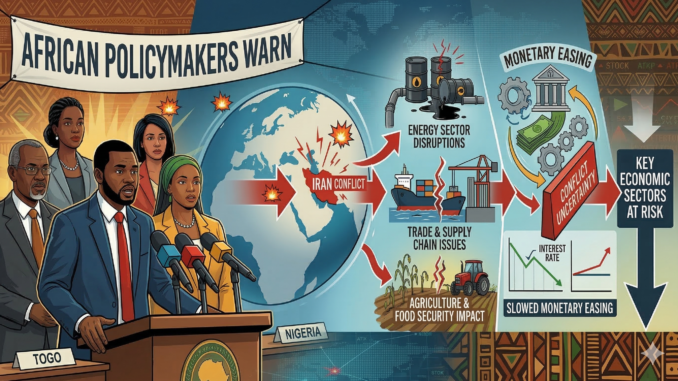


African policymakers have raised concerns that the surge in global oil prices triggered by tensions involving Iran could create serious challenges for economic stability across the continent. Officials say the price shock may disrupt important sectors such as mining and threaten Africa’s fragile economic recovery.
In recent months, several central banks across Africa – from Accra to Luanda – had begun lowering lending rates as inflation eased and foreign exchange markets stabilized. The rate cuts were aimed at supporting economic growth and stimulating business activity.
However, the escalating geopolitical tensions may force policymakers to reconsider their approach.
The central bank of Uganda told Reuters that increasing global uncertainty is making monetary policy decisions more complicated for central banks worldwide. The bank noted that it had already taken a cautious stance before the conflict escalated and will now reassess its policy tools to ensure they remain effective in a more challenging economic environment.
Meanwhile, the central bank of Angola kept its interest rates unchanged on Thursday after three consecutive rate cuts. Governor Manuel Tiago Dias said the decision was influenced by growing global risks, particularly the possibility that the Middle East conflict could continue for an extended period. According to him, prolonged instability could disrupt supply chains, including the distribution of agricultural inputs and fertilizers.
Economists believe other major African economies may also reconsider their monetary policies. Analysts expect central banks in Ghana, Nigeria, Zambia and Kenya to slow or temporarily pause their rate-cutting cycles as they monitor the effects of rising oil prices on inflation.
Razia Khan, chief economist for the Middle East and Africa at Standard Chartered, explained that policymakers will have to closely examine how higher energy costs could filter through the economy and increase inflation.
Financial institutions are already adjusting their forecasts. Analysts at JPMorgan have reduced their expectations for interest-rate cuts in several African countries, including Nigeria, Kenya, Ghana and Zambia, due to the economic uncertainty created by the crisis.
Global oil markets have reacted strongly to the situation. Brent crude futures were trading close to $100 per barrel on Friday after briefly approaching $120 earlier in the week.
According to Charlie Robertson, head of macro strategy at FIM Partners, sustained oil prices around $100 per barrel could reduce foreign exchange reserves across many African countries and weaken several local currencies by around 5%.
Key Economic Sectors Could Feel the Pressure
Experts warn that economic turbulence could affect nearly every country in the region, including oil-producing nations such as Nigeria and Angola.
Marie Diron, managing director of global sovereign risk at Moody’s, said that although higher oil prices may increase government revenues for exporters, the broader global economic slowdown could offset those gains.
Nigeria, West Africa’s largest oil producer, may be better positioned to manage the situation than in the past. The government ended costly fuel subsidies in 2023, and the launch of the massive Dangote Refinery has helped improve domestic refining capacity.
Nevertheless, Nigeria’s finance ministry said volatility in global energy markets is already pushing up prices for fuel, diesel, cooking gas and fertilizer within the country.
In East Africa, Kenya has experienced a decline in bond prices since the crisis began. However, the government says fuel supplies remain stable for the time being. Energy Minister Opiyo Wandayi assured the public that current fuel reserves are sufficient and authorities are monitoring the situation closely.
Neighboring Ethiopia has increased fuel subsidies to help shield consumers from rising costs. Meanwhile, the government of Zambia has warned fuel retailers against hoarding petroleum products, emphasizing that national fuel stocks remain adequate.
Mining and Other Key Industries at Risk
The economic shock could also affect vital industries such as mining, which is a major source of foreign currency for several African economies.
Paul Kabuswe, Zambia’s minister of mines, warned that rising fuel costs could reduce productivity in the mining sector.
He noted that higher fuel prices would increase operational costs for mining companies, potentially affecting output and export earnings.
Our hope is that the conflict ends soon,” Kabuswe said, highlighting concerns that prolonged geopolitical tensions could undermine Africa’s economic recovery.
Leave a Reply