
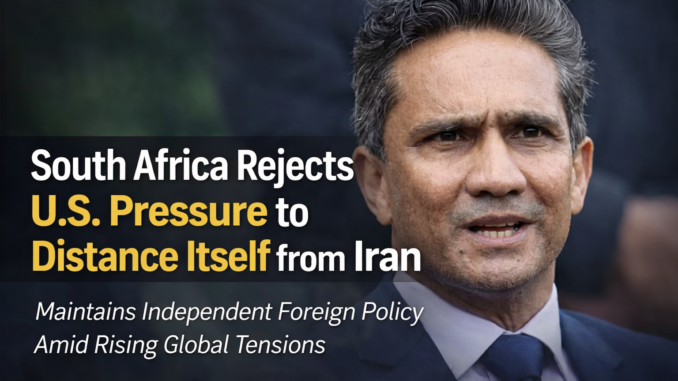


Johannesburg, March 16 — South Africa has made it clear that it sees no justification for severing diplomatic relations with Iran, according to its Director-General of International Relations, Zane Dangor. His remarks come after comments from the newly appointed U.S. ambassador suggested that Pretoria’s ties with Iran could hinder stronger relations with Washington.
In a recent interview, Dangor firmly pushed back against multiple demands reportedly linked to the U.S. administration. These include calls for South Africa to withdraw its case against Israel at the International Court of Justice, reconsider its Black economic empowerment policies, and accept a refugee program specifically for white South Africans.
His statements come at a time of heightened global tension due to the ongoing conflict involving Iran, which has placed additional pressure on countries managing diplomatic ties with Tehran. The situation has also contributed to a noticeable strain in relations between South Africa and the United States during President Donald Trump’s second term.
Economic tensions have further escalated following the U.S. decision to impose a 30% tariff on South African imports— a move that could significantly impact employment in a country already facing high unemployment levels.
Dangor emphasized that while South Africa maintains its relationship with Iran, it does not do so uncritically. He noted that the government has previously raised concerns over Iran’s internal actions, including its response to protests and regional military activities. However, he stressed that South Africa will not be drawn into geopolitical power struggles or align itself with any major global bloc.
Responding to the U.S. ambassador’s remarks, Dangor pointed out that different countries have varying relationships with Iran, particularly across the developing world, and these differences should be respected.
Strained U.S.–South Africa Relations
Relations between Pretoria and Washington have reached a low point in recent years. Tensions have been fueled in part by controversial claims from the U.S. regarding the treatment of South Africa’s white minority—claims that the South African government has strongly denied.
Despite these challenges, Dangor indicated that South Africa remains open to improving ties with the United States, but only through constructive dialogue focused on areas of mutual agreement.
On the issue of South Africa’s legal case against Israel at the International Court of Justice, Dangor made it clear that the matter is non-negotiable, describing it as an independent legal process rather than a political bargaining point.
He also rejected suggestions that domestic policies aimed at addressing the legacy of apartheid—such as Black ownership and employment requirements—should be altered in response to external pressure or trade negotiations.
Concerns Over U.S. Refugee Policy
Addressing the proposed U.S. refugee program for white South Africans, Dangor criticized the initiative as preferential and inconsistent with standard international procedures. He stated that any immigration process should follow established legal channels rather than being framed under refugee status.
This position was reinforced by South Africa’s decision to deny entry to a Kenya-based organization involved in processing such applications, citing concerns over the legitimacy of the program.
Conclusion
South Africa has reaffirmed its commitment to an independent foreign policy, resisting external pressure to alter its diplomatic relationships or domestic priorities. While open to engagement with global partners, the country remains firm in its stance against being influenced by geopolitical rivalries.
Leave a Reply