
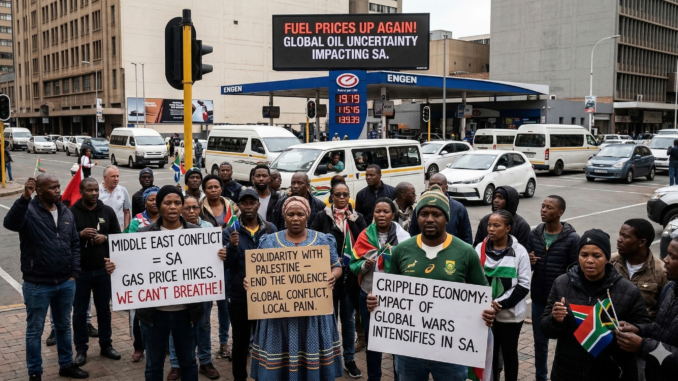


South Africa is increasingly feeling the economic and political effects of the ongoing conflict involving the United States, Israel, and Iran, as policymakers and political leaders raise concerns over its domestic implications.
As the conflict entered its third week, members of the South African Parliament engaged in a robust debate on the country’s foreign policy stance and the broader consequences of the war. While political parties remain divided in their support for different actors, there is broad consensus that the conflict is having adverse effects on South Africa’s economy and citizens.
Rising Costs and Pressure on Households
ActionSA Member of Parliament Malebo Kobe highlighted the far-reaching economic impact of the conflict, noting that disruptions to global oil supply—particularly through the Strait of Hormuz—have triggered significant volatility in energy markets.
She warned that rising oil prices could lead to a sharp increase in fuel costs, directly affecting everyday South Africans. Higher transport expenses, increased food production costs, and escalating prices of goods and services are expected to intensify the cost-of-living crisis.
Kobe emphasized that vulnerable communities will be disproportionately affected, as higher commuting costs and inflationary pressures strain already limited household incomes.
Economic Growth at Risk
The conflict is also expected to weigh heavily on South Africa’s already fragile economic growth. Kobe cautioned that prolonged instability could exacerbate unemployment and deepen poverty levels, placing additional pressure on the Government of National Unity.
She called for immediate policy interventions, including temporary fuel levy relief to cushion consumers from sudden price spikes—similar to measures implemented during the Russia-Ukraine War.
Additionally, she stressed the urgency of accelerating energy diversification to reduce reliance on imported fuel. Expanding investment in renewable energy and strengthening local refining capacity were identified as critical steps toward improving long-term resilience.
Currency Weakness and Inflation Concerns
Leader of Build One South Africa, Mmusi Maimane, noted that the ongoing conflict has contributed to the weakening of the national currency, further intensifying inflationary pressures.
He warned that fuel prices could rise significantly in the coming months, with ripple effects across transportation, food, and essential services. Maimane urged Parliament to consider delaying fuel levy increases in order to protect consumers from escalating costs.
He also underscored the importance of strengthening diplomatic engagement, calling for the urgent appointment of a South African ambassador to the United States to safeguard national interests and support trade negotiations.
Trade and Export Challenges
Minister of Trade, Industry and Competition, Parks Tau, highlighted the broader economic risks, noting that global oil prices—measured by Brent crude—have surged beyond $100 per barrel.
He emphasized that the financial burden of geopolitical conflict is often borne by developing economies, including South Africa. With bilateral trade between South Africa and the Middle East valued at approximately $15.3 billion and growing steadily, prolonged instability could result in significant export losses.
Tau warned that if the conflict continues, South Africa may face substantial revenue declines, particularly in export-driven sectors.
Conclusion
As the Middle East conflict continues, South Africa faces mounting economic challenges, from rising fuel prices and inflation to potential trade disruptions. Policymakers are increasingly calling for proactive measures to shield the economy and protect citizens from the far-reaching consequences of global geopolitical instability.
Leave a Reply