
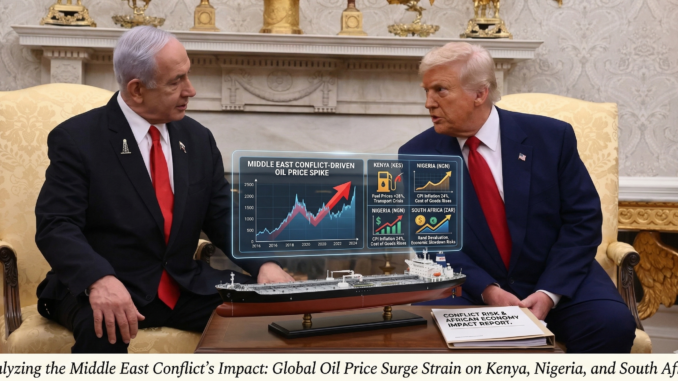


The recent escalation in the Middle East conflict—triggered by U.S. and Israeli attacks on Iran on 28 February 2026—has significantly disrupted global oil supply chains. A major consequence has been Iran’s closure of the Strait of Hormuz, a critical route responsible for transporting nearly 20% of the world’s oil supply.
As a result, global oil prices have surged beyond $100 per barrel, marking one of the most severe supply shocks in modern energy markets. According to the International Energy Agency, this crisis represents one of the largest disruptions in the history of the global oil market.
The ripple effects are being felt worldwide, including across Africa. Even oil-producing nations are not immune. Scholars from Nigeria, South Africa, and Kenya unanimously agree that rising oil prices are adversely affecting their economies, primarily through increased fuel costs—a critical input for both households and industries.
Higher fuel prices are also raising concerns about food security, as energy costs directly influence agricultural production and fertilizer prices. Some governments, such as Ethiopia’s, have already introduced fuel subsidies to cushion citizens from the immediate impact.
Nigeria: Rising Inflation Despite Oil Windfalls
For Nigeria, the situation presents a paradox. While the country stands to benefit from higher oil revenues, the broader economic impact remains negative.
Increased oil prices are expected to drive up global inflation, reversing recent declines. As a heavily import-dependent economy, Nigeria will face higher costs for goods and services, ranging from machinery and fuel to food and pharmaceuticals. This could significantly inflate the country’s import bill, potentially outweighing any additional oil revenue gains.
Inflation, already elevated at around 27% in 2025, is likely to worsen. Rising fertilizer costs will also affect agricultural productivity, leading to higher food prices and increased food insecurity.
Although Nigeria could earn billions in additional oil revenue depending on the duration of the conflict, historical patterns raise concerns. Past windfalls have often been undermined by weak governance, lack of transparency, and inefficient allocation of resources. As a result, ordinary citizens rarely experience direct benefits.
To maximize impact, experts suggest channeling such revenues into infrastructure development, manufacturing, education, and healthcare, rather than short-term fiscal fixes.
South Africa: Severe Impact Due to Import Dependence
South Africa is particularly vulnerable, as it relies entirely on imported oil and refined fuels. The surge in global oil prices is already increasing costs across multiple sectors, including transport, agriculture, and energy.
Fuel prices in South Africa are largely based on import parity pricing, meaning global price shocks are quickly transmitted into the domestic market. Within just 10 days of the conflict escalation, petrol prices rose by approximately 23%.
The consequences are widespread:
- Increased transportation and logistics costs
- Higher electricity prices due to diesel-powered backup generation
- Rising food prices driven by agricultural fuel constraints
Fuel shortages have already begun to emerge, forcing some suppliers to limit sales. If the conflict persists, the country could face fuel rationing similar to measures implemented during the 1973 oil crisis.
Kenya: Economic Pressure with Limited Policy Options
Kenya, which imports most of its oil—primarily from the Middle East—is also facing mounting pressure. Disruptions in supply chains, particularly following attacks on key UAE oil infrastructure, are expected to raise fuel import costs.
The government regulates fuel prices, and any increase in global prices will likely be reflected in upcoming pricing cycles. While subsidies could offer temporary relief, Kenya’s fiscal constraints and budget deficit make this option unlikely.
Higher fuel prices will significantly impact:
- Public transportation costs
- Cost of living
- Inflation levels across sectors
With general elections approaching in 2027, rising fuel and living costs could also have political implications.
Although Kenya discovered oil in 2012, production remains limited due to infrastructure and investment challenges. While higher global prices may improve the viability of local production, scaling up operations will take time and significant capital investment.
Conclusion
The Middle East conflict has triggered a global energy shock with far-reaching consequences. For African economies such as Nigeria, South Africa, and Kenya, the effects are largely negative—manifesting through inflation, rising living costs, and economic uncertainty.
While oil-exporting nations like Nigeria may see short-term revenue gains, structural challenges and governance issues limit the broader economic benefits. Meanwhile, oil-importing countries such as South Africa and Kenya face immediate and widespread economic strain.
In the short to medium term, consumers across these nations should prepare for higher fuel prices, increased inflation, and rising costs of essential goods and services.
Leave a Reply