
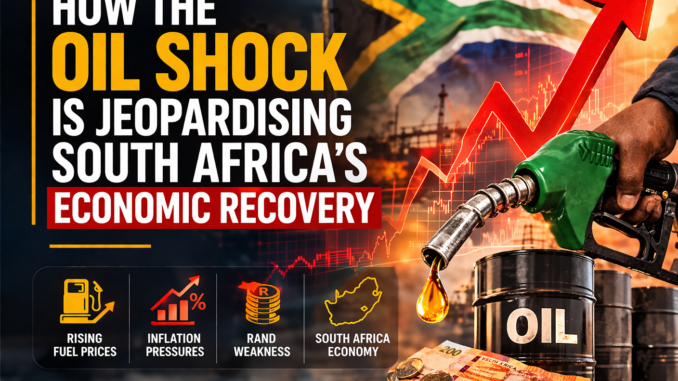


South Africa’s already fragile economic recovery is facing renewed pressure following a sharp surge in global oil prices, triggered by escalating conflict involving Iran. The geopolitical crisis has sent shockwaves through global financial markets, raising concerns about inflation, fuel costs, and overall economic growth.
Prior to the disruption, there were early signs of stabilisation. The PayInc Economic Index, which tracks the monthly value of electronic transactions, recorded a modest improvement in February.
According to Shergeran Naidoo, Head of Stakeholder Engagements at PayInc:
“The PayInc Economic Index increased by 0.4% to reach 103.9 in February. At 3.5% above year-ago levels, the index signalled resilience in economic activity at the start of the year.”
Transaction volumes also reflected positive momentum, rising slightly from January and showing a strong 12.5% increase compared to the previous year.
War Triggers Economic Uncertainty
However, the outbreak of conflict on 28 February has significantly altered the outlook.
Independent economist Elize Kruger noted:
“While geopolitical risks were anticipated, a full-scale war was not. Even a short-lived conflict could have far-reaching consequences for both global and local economic prospects.”
The most immediate and visible impact is expected at fuel pumps, where consumers are likely to face unprecedented price increases.
Record Fuel Price Increases Expected
Global oil prices have surged by over 40% in March, reaching their highest levels since 2022. This spike followed U.S. and Israeli strikes on Iran and Tehran’s subsequent closure of the Strait of Hormuz—a critical artery for global oil supply.
The situation has been further exacerbated by the weakening South African rand, significantly increasing the cost of fuel imports.
Kruger warns that:
“These increases could be the highest ever implemented in a single month in South Africa and may derail the country’s fragile economic recovery in 2026.”
There is also a strong احتمال that fuel prices may continue rising in the coming months, prolonging economic strain.
Inflation and Interest Rate Pressures
Rising fuel costs are expected to push inflation higher, complicating the outlook for interest rates.
According to Maarten Ackerman, Chief Economist at Citadel:
“The environment has shifted significantly. Oil prices above $100 per barrel, combined with pressure on the rand, are likely to intensify inflation risks.”
Higher transport and logistics costs typically cascade into other sectors, particularly food, further increasing the cost of living.
As a result, expectations for interest rate cuts in 2026 have largely diminished, reversing earlier projections by the South African Reserve Bank.
Emerging Markets Under Pressure
Emerging markets like South Africa are especially vulnerable due to their reliance on imported energy.
Kristof Kruger of Prescient Securities explains:
“The transmission is immediate and unforgiving—currency weakens, fuel prices rise, and inflation expectations adjust rapidly.”
This creates a disproportionate economic burden compared to developed economies, intensifying financial instability.
Global Market Volatility
The oil shock is no longer just an energy issue—it has evolved into a broader macroeconomic challenge.
Trevor Garvin from Nedgroup Investments highlights:
“At these levels, oil becomes a macroeconomic and inflation shock, complicating central bank policies, pressuring growth, and increasing market volatility.”
Global markets have already begun reacting to the disruption, reflecting heightened uncertainty.
Investment Opportunities Amid the Crisis
Despite the challenges, certain sectors may benefit from the current environment.
According to Andrew Bahlmann of Deal Leaders International:
“Higher commodity prices could support sectors like mining and energy. South Africa’s strong base in precious metals—such as gold, platinum, and palladium—may attract increased investment and strategic acquisitions.”
Additionally, rising energy costs are likely to accelerate the transition toward renewable energy, with growing interest from international investors, particularly from Gulf nations.
Renewable energy and infrastructure development could emerge as key investment hotspots, even amid broader economic uncertainty.
Conclusion
The surge in global oil prices has introduced significant risks to South Africa’s economic recovery. Rising fuel costs, increasing inflation, and shifting monetary policy expectations are likely to weigh heavily on growth prospects in the coming months.
While select sectors may benefit, the overall outlook remains challenging, with both consumers and businesses expected to face sustained economic pressure.
Leave a Reply