
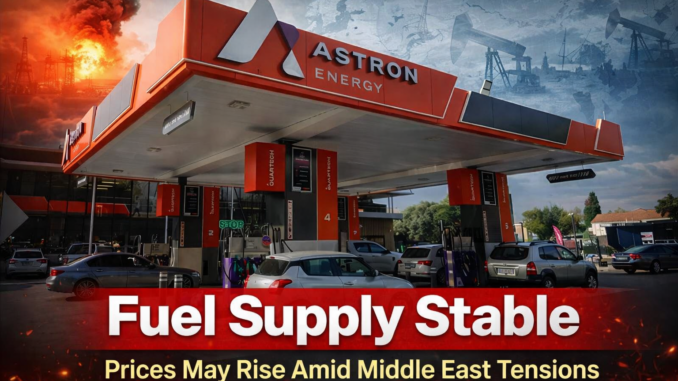


JOHANNESBURG, March 26 — South Africa has confirmed that its fuel supply remains stable despite relatively low strategic reserves, even as escalating tensions in the Middle East raise concerns about future availability and pricing pressures.
Speaking during a virtual media briefing, the Department of Mineral and Petroleum Resources (DMPR), alongside the Fuel Industry Association of South Africa, stated that the country currently holds approximately 8 million barrels of crude oil in strategic reserves, equivalent to about two weeks of supply. This marks a significant decline from the nation’s previous storage capacity of around 45 million barrels, following reserve sales in 2016 and 2022.
Despite the reduced reserves, officials emphasized that there is no immediate cause for concern. South Africa sources less than 70% of its petroleum imports from the Middle East, with additional supply secured from countries such as Angola and Nigeria, ensuring a diversified import base.
Robert Maake, Director of the Fuel Pricing Mechanism at the DMPR, noted that the country is not currently relying on its strategic reserves, as sufficient fuel continues to flow from global markets outside the Middle East.
However, authorities cautioned that a prolonged geopolitical conflict could disrupt global oil markets, potentially affecting supply stability and driving prices higher in the coming months.
Maake indicated that South Africa could face notable fuel price increases as early as April, comparable to the surge witnessed in February 2022 following the outbreak of the Russia-Ukraine conflict. As of now, no specific government interventions have been announced to mitigate the anticipated price hikes.
Estimates suggest that petrol prices could rise by up to 6 rand per litre, while diesel may increase by as much as 10 rand per litre, potentially triggering higher transportation and food costs. Minibus taxi operators have already signaled the likelihood of fare increases.
In addition, rising diesel demand—particularly within the agricultural sector—has led to sporadic regional shortages. According to AgriSA CEO Johann Kotze, panic buying has exacerbated supply constraints, especially in the Western Cape and Eastern Cape.
Kotze further warned that ongoing uncertainty, combined with rising diesel costs, could have serious implications for agricultural productivity and food security in the months ahead.
Leave a Reply