
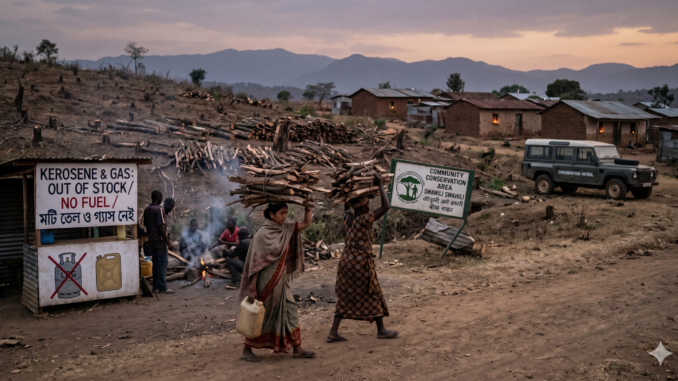


NAIROBI, Kenya (AP) — Not long ago, preparing dinner was simple for Brenda Obare. With a quick turn of a knob, a steady blue flame would light up her kitchen stove.
Today, that convenience has vanished.
Instead, she bends over a charcoal stove outside her tin-roofed home in Kibera—one of Nairobi’s largest informal settlements—struggling to ignite a smoky fire. Cooking gas has become too costly and unreliable, leaving charcoal as her only dependable option.
“We don’t really have a choice,” she says. “We use whatever we can afford.”
Her situation reflects a growing reality across Africa and South Asia, where energy disruptions—triggered by geopolitical tensions such as the Iran conflict—are forcing households to abandon cleaner fuels like LPG (liquefied petroleum gas) and return to traditional, more harmful alternatives.
A Setback for Clean Energy Progress
For years, governments encouraged the shift to cleaner cooking fuels to improve public health and protect the environment. According to global health data, indoor air pollution caused nearly 2.9 million deaths in 2021. Reducing reliance on firewood and charcoal was also essential to slowing deforestation and preserving wildlife habitats.
But rising fuel costs are reversing that progress.
As LPG, kerosene, and electricity become unaffordable, families are reverting to firewood and charcoal—fuels that are easier to access in low-income communities but carry serious environmental and health consequences.
Forests Under Pressure
This shift is putting immense strain on forests and ecosystems.
Increased demand for wood fuels is driving people deeper into previously untouched forest areas. This not only accelerates deforestation but also disrupts wildlife habitats and fragile ecosystems.
Environmental experts warn that this trend could have cascading effects, including:
- Loss of biodiversity
- Degradation of watersheds
- Increased human-wildlife conflict
As people venture further into forests for fuel, encounters with wildlife are becoming more frequent, raising safety concerns for both humans and animals.
Rising Risks for Wildlife and Public Health
Economic hardship can also lead to increased poaching and bushmeat hunting as people search for alternative food sources. This not only threatens wildlife populations but also raises the risk of zoonotic diseases—illnesses transmitted from animals to humans.
At the same time, declining tourism—driven by higher travel costs—reduces funding for conservation programs. In countries like Kenya and Tanzania, tourism contributes significantly to the economy and supports:
- National parks
- Anti-poaching operations
- Community conservation projects
A drop in visitors means fewer resources for protecting wildlife.
Impact Spreads to South Asia
The situation is not limited to Africa.
In India, one of the world’s largest LNG importers, rising fuel prices are forcing low-income households to abandon LPG. In areas like Bhalswa near New Delhi, many families—already surviving on minimal incomes—are returning to firewood or relocating to rural areas where fuel is easier to access.
Social workers report that years of effort to promote clean cooking solutions are now at risk of being undone.
Women and Girls Bear the Burden
The shift back to traditional fuels disproportionately affects women and girls. They often spend hours each day collecting firewood, reducing time available for education, work, or other opportunities.
This reversal not only impacts livelihoods but also slows progress toward gender equality.
Agriculture and Food Security at Risk
The energy crisis is also affecting agriculture. Rising diesel and fertilizer costs are expected to:
- Lower crop yields
- Increase food prices
- Worsen food insecurity
The effects extend far beyond energy, influencing entire economic and social systems.
Conservation Efforts Face New Challenges
Protecting wildlife becomes more difficult as fuel prices rise. Conservation teams rely on vehicles to patrol remote areas and respond quickly to emergencies. Higher fuel costs limit mobility, delaying critical interventions during human-wildlife conflicts.
Even minor delays can lead to injuries, fatalities, or escalating tensions.
A Call for Urgent Action
Experts emphasize the need for immediate measures to prevent long-term damage. Suggested solutions include:
- Targeted subsidies to keep clean fuels affordable
- Strengthening local fuel supply chains
- Investing in renewable alternatives such as solar, biogas, and geothermal energy
There is also a growing call to treat conservation as essential infrastructure—especially during economic crises.
The Bigger Picture
What began as an energy disruption is now reshaping daily life, environmental stability, and conservation efforts across two continents. Without timely intervention, years of progress in clean energy adoption and ecosystem protection could be lost.
Leave a Reply