
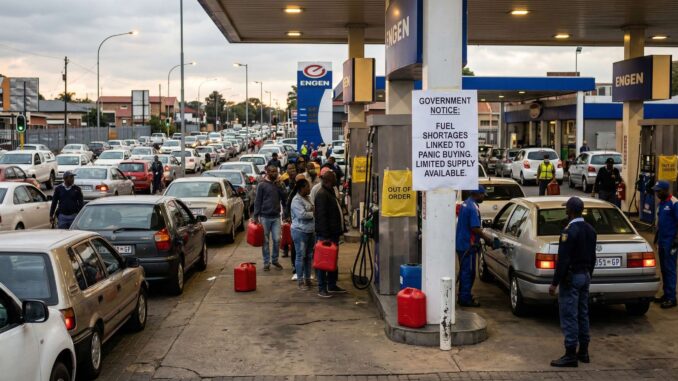


South Africa’s Cabinet has pointed to panic buying and fuel hoarding as the primary reasons behind fuel shortages at petrol stations across the country. According to officials, these behaviors have placed significant pressure on the fuel distribution system, leading to temporary supply disruptions.
The government has urged citizens to remain calm and avoid unnecessary stockpiling, especially amid ongoing concerns about global supply due to tensions in the Middle East.
These remarks followed Cabinet discussions held on 25 March 2026 and a subsequent special meeting on 1 April 2026, where the country’s fuel situation was reviewed in detail.
Fuel Supply Still Stable, Says Cabinet
Despite visible shortages at some stations, the Cabinet reassured the public that South Africa’s fuel supply remains stable in the short term. Officials clarified that while the country imports refined fuel products from the Middle East, it does not rely entirely on the region for crude oil.
Economic analysts from Momentum Investments, Sanisha Packirisamy and Tshiamo Masike, highlighted that only about 25% of South Africa’s crude oil imports come directly from the Persian Gulf. A large portion is sourced from African countries including Nigeria, Angola, and Ghana.
However, the country has increasingly depended on imported refined fuels like petrol and diesel due to the shutdown of several local refineries over the past decade.
Global Risks Still Impact Local Fuel Market
Experts warn that any disruption in key global supply routes—particularly the Strait of Hormuz—could still affect South Africa’s fuel availability and pricing.
As a price-taker in the global oil market, the country remains vulnerable to rising international oil prices. This not only impacts fuel costs but also increases transportation expenses and weakens consumer confidence.
The ongoing Middle East conflict has raised fears that restricted shipping routes could lead to tighter domestic supply conditions and higher prices.
Declining Refining Capacity a Major Concern
South Africa’s reliance on imported fuel has grown significantly due to reduced local refining capacity. Over the years, refinery closures have limited the country’s ability to meet its own fuel demand.
If global disruptions persist, there are concerns that local reserves may struggle to keep up with demand, especially during periods of increased consumption.
Recent reports of petrol stations running dry or limiting diesel sales have further intensified public anxiety.
Government Response and Intervention Measures
In response to the situation, the Cabinet reiterated that current shortages are largely logistical, not due to a lack of supply. The issue has been attributed to sudden spikes in demand caused by panic buying.
To address the broader impact of rising fuel costs, Cyril Ramaphosa has established a Ministerial Task Team. This group includes key departments such as Finance, Transport, Energy, Trade, Agriculture, and International Relations.
The task team is focused on minimizing the impact of global events on:
- Fuel prices
- Cost of living
- Food security
- Fuel Levy
- Relief Announced
As an immediate step, the government introduced a temporary reduction in the fuel levy to ease pressure on consumers.
On 31 March 2026, Finance Minister Enoch Godongwana announced a R3 per litre fuel levy cut for April, with additional relief measures under consideration for May and June.
This move came after projections showed a significant under-recovery in fuel prices, driven by rising global oil costs and a weaker rand.
Inflation Risks Remain
While the levy reduction has provided short-term relief, economists warn that rising fuel costs could still lead to broader inflation, particularly affecting food prices and essential goods.
Energy-driven inflation may gradually spread across the economy, impacting households and businesses alike.
Temporary Relief from Global Tensions
In a positive development, a two-week ceasefire between the United States and Iran has been announced. This is expected to allow safe passage through the Strait of Hormuz during this period, potentially easing immediate supply concerns.
Conclusion
Although fuel shortages at certain stations have caused concern, the government maintains that there is no immediate supply crisis. However, South Africa’s dependence on imported fuel and exposure to global market fluctuations continue to pose long-term risks.
Leave a Reply